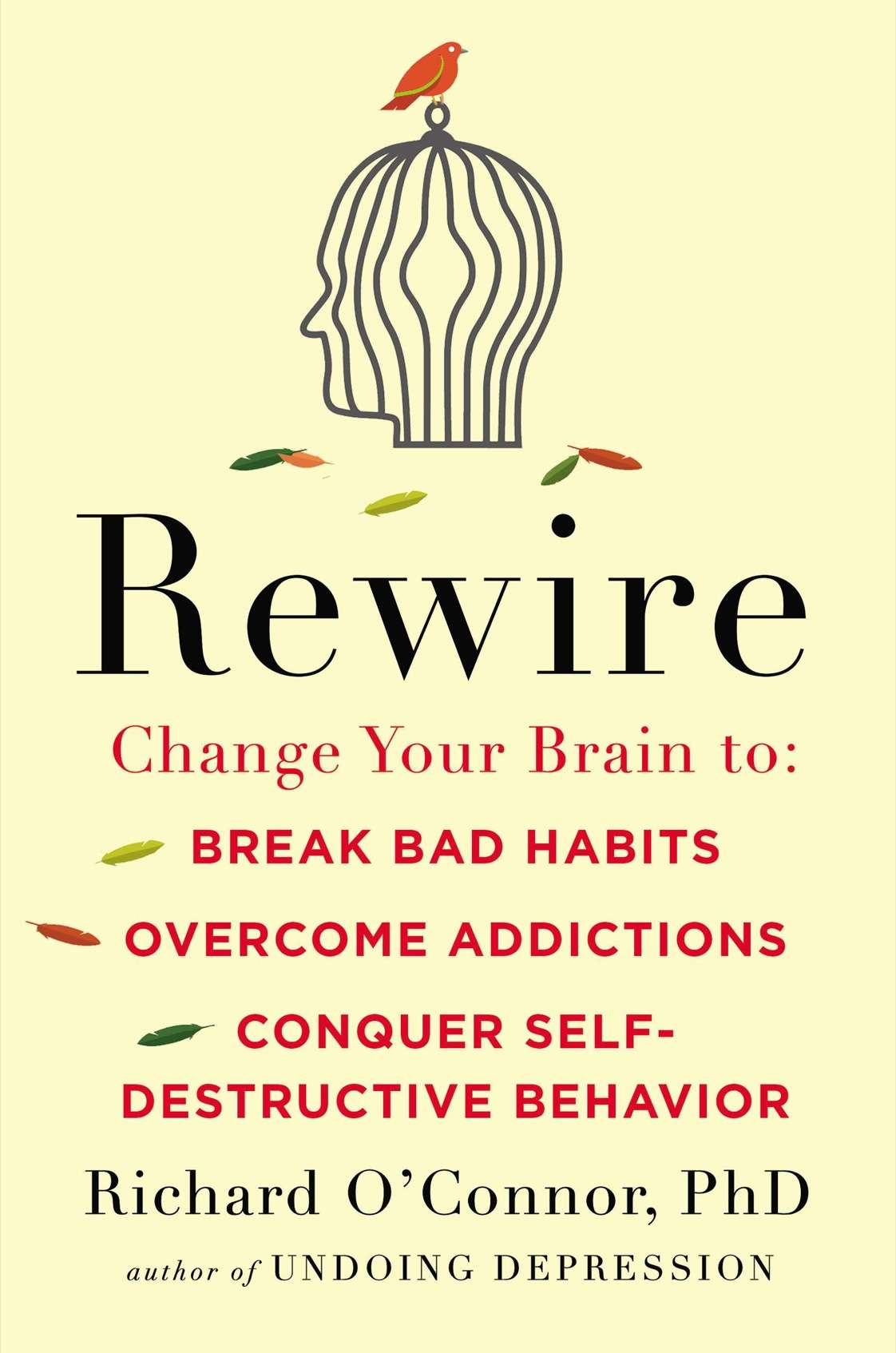
Rewire: Change Your Brain to Break Bad Habits, Overcome Addictions,Conquer Self-Destructive Behavior by Richard O'Connor
Author:Richard O'Connor [O'Connor, Richard]
Language: eng
Format: epub
Publisher: Penguin Group US
Published: 2014-07-31T00:00:00+00:00
Weight Loss
* * *
Most Americans are, or believe they are, overweight. Is this the result of self-destructive behavior? The answer is more complicated than you might think. Any of the scenarios of self-destruction we’ve reviewed can contribute to poor eating habits or lack of exercise, but the struggle to lose weight takes on a life of its own. Consider that the William Hill agency, an English bookmaking firm, has a standing offer open to anyone: You set your own weight loss goals and plan, and they will bet against your success. Despite the fact that you get to dictate what your goal and time frame are, most bettors lose. This is because diets don’t work. Each time you diet, lose weight, and put it back on again, you make it much harder to lose weight in the future. Your body starts to treat diets as famines, and will retain its calories because it thinks your survival is threatened. By the third or fourth diet, you can drastically restrict your intake but your body will hold on to its weight.
Will power therefore has little to do with successful weight loss. Of course it takes will power to stick to a diet; the problem is that diets don’t work. Just consider Oprah Winfrey. To get to where she is, to juggle all her commitments and projects, she has to be an outstandingly determined and organized person. Yet she struggles to keep her weight off, despite the help of the world’s greatest experts and coaches. Dieters who are in a depleted state (who have temporarily drained their will power reservoir by controlling themselves in other ways) have a harder time sticking to their diets. Those who have been severely tempted have little will power left over for other things. We want to make your eating changes part of the automatic self, so you’re not using will power.
Dieters are particularly subject to the what-the-hell effect. One experiment (since replicated many times) compared dieters with nondieters under different conditions. Some were given two giant milk shakes, then given free access to cookies and crackers, which they thought they were rating for taste—but actually the researchers were measuring consumption. Others were given a small milk shake, and a third group nothing at all. Among nondieters, the results were just what you would expect: The group who had no milk shake ate the most cookies and crackers, the small milk shake group ate less, and the double milk shake group ate least of all. But among dieters, the results were stunningly contradictory—the group who’d had two giant milk shakes ate more cookies and crackers than any other group. It seems as if dieters have a specific number of calories that is their daily target, and if they blow it (as they would with two milk shakes), the day is a waste. What the hell, might as well eat everything today, and take a fresh start tomorrow. It’s totally irrational, but automatic, and the rational part of the self is not making decisions here.
Download
This site does not store any files on its server. We only index and link to content provided by other sites. Please contact the content providers to delete copyright contents if any and email us, we'll remove relevant links or contents immediately.
Personalized inhaled bacteriophage therapy for treatment of multidrug-resistant Pseudomonas aeruginosa in cystic fibrosis by unknow(209927)
CONSORT 2025 statement: updated guideline for reporting randomized trials by unknow(102495)
Critical evaluation of the ProfiLER-02 study design and outcomes by Vivek Subbiah & Razelle Kurzrock(102023)
Cardiac gene therapy makes a comeback by Oliver J. Müller & Susanne Hille & Anca Kliesow Remes(101814)
Whisky: Malt Whiskies of Scotland (Collins Little Books) by dominic roskrow(74600)
Unveiling the design rules for tunable emission in graphene quantum dots: A high-throughput TDDFT and machine learning perspective by Şener Özönder & Mustafa Coşkun Özdemir & Caner Ünlü(50989)
A yeast-based oral therapeutic delivers immune checkpoint inhibitors to reduce intestinal tumor burden by unknow(40366)
Covalent hitchhikers guide proteins to the nucleus by Alexander F. Russell & Madeline F. Currie & Champak Chatterjee(40290)
Meet the Authors: Christopher R. Mansfield and Emily R. Derbyshire by Christopher R. Mansfield & Emily R. Derbyshire(40192)
Alkaline-earth metals promote propane dehydrogenation with carbon dioxide through geometric effects: Altering the reaction pathway by unknow(32809)
Induced iron vacancies boosting FeOOH loaded on sustainable Fenton-like collagen fiber membrane for efficient removal of emerging contaminants by unknow(32605)
Efficient electric-field-assisted photochemical conversion of methane to n-propanol exclusively over penetrated TiO2Ti hollow fibers by Guanghui Feng(32525)
Bi2SiO5 nanosheets as piezo-photocatalyst for efficient degradation of 2,4-Dichlorophenol by Hangyu Shi & Yifu Li & Lishan Zhang & Guoguan Liu & Qian Zhang & Xuan Ru & Shan Zhong(32462)
A novel NDIPTA organic heterojunction photocatalyst with built-in electric field for efficient hydrogen production by Jiahui Yang & Baojun Ma & Yongfa Zhu(32436)
Enhanced conversion of methane to liquid-phase oxygenates via hollow ferrite nanotube@horseradish peroxidase based photoenzymatic catalysis by Jun Duan & Shiying Fan & Xinyong Li & Shaomin Liu(32400)
Ordered macroporous superstructure of defective carbon adorned with tiny cobalt sulfide for selective electrocatalytic hydrogenation of cinnamaldehyde by Xiao-Shi Yuan & Sheng-Hua Zhou & San-Mei Wang & Wenbo Wei & Xiaofang Li & Xin-Tao Wu & Qi-Long Zhu(32327)
What's Done in Darkness by Kayla Perrin(27238)
Topological analysis of non-conjugated ethylene oxide cored dendrimers decorated with tetraphenylethylene: Insights from degree-based descriptors using the polynomial approach by A Theertha Nair & D Antony Xavier & Annmaria Baby & S Akhila(26621)
Investigation of mechanical and self-healing properties of hydroxyl-terminated polybutadiene functionalized with 2-ureido-4-pyrimidinone by Mohsen Kazazi & Mehran Hayaty & Ali Mousaviazar(26550)
